
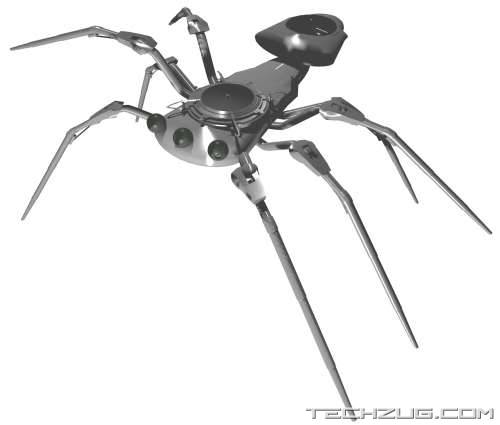

BAE Systems will lead a team of scientists that will develop miniature robots to improve military situational awareness. The company signed a $38 million agreement with the U.S. Army Research Laboratory to lead an alliance of researchers and scientists from the Army, academia and industry.
The Micro Autonomous Systems and Technology (MAST) Collaborative Technology Alliance will research and develop advanced robotic equipment for use in urban environments and complex terrain, such as mountains and caves. The alliance will create an autonomous, multifunctional collection of miniature intelligence-gathering robots that can operate in places too inaccessible or dangerous for humans.
?Robotic platforms extend the warfighter?s senses and reach, providing operational capabilities that would otherwise be costly, impossible, or deadly to achieve,? said Dr. Joseph Mait, MAST cooperative agreement manager for the Army Research Laboratory. ?The MAST alliance is a highly collaborative effort, with each partner from government, academia, and industry playing a significant role.?
MAST will advance fundamental science and technology for future robotic systems in several key areas, including small-scale aeromechanics and ambulation; propulsion; sensing, processing and communications; navigation and control; microdevices and integration; platform packaging; and systems architectures.
?The technologies that will be developed under MAST represent capabilities and techniques that will influence nearly all of the products that BAE Systems will develop and produce in the future,? said Steve Scalera, MAST program manager for BAE Systems in Merrimack, New Hampshire. ?We and our alliance partners have committed our brightest minds to make the MAST program a success.?
The Alliance has a planned duration of five years with an option to extend for an additional five years. MAST consists of four primary research areas, led by four principal alliance members: BAE Systems will lead Microsystems Integration, the University of Michigan will lead Microelectronics, the University of Maryland will lead Microsystem Mechanics, and the University of Pennsylvania will lead Processing for Autonomous Operation.
The alliance also has five general members participating in one or more of the research areas: the University of California at Berkeley, the California Institute of Technology and the Jet Propulsion Laboratory, the Georgia Institute of Technology, the University of New Mexico, and North Carolina Agricultural and Technical State University.